
The Leadership and Legacy of Andrew Billingsley
The Leadership and Legacy of Andrew Billingsley
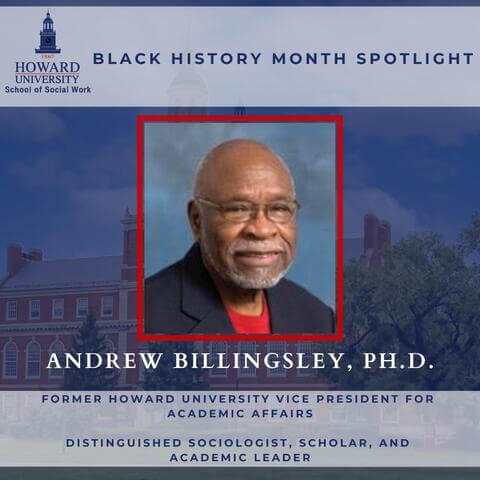
As we celebrate this year’s Black History Month, the Howard University School of Social Work honors Andrew Billingsley, Ph.D., a distinguished sociologist, scholar, and academic leader. His enduring legacy reflects a vision that helped shape a pivotal period in Howard University’s history, particularly within the School of Social Work and its commitment to the Black Perspective.
In 1970, Billingsley came to Howard University as Vice President for Academic Affairs under President James E. Cheek, during a transformative moment defined by the theme “A New Direction.” This period marked a clear break from the past and a renewed focus on academic rigor, institutional strength, and scholarly leadership.
Before assuming the vice presidency, Billingsley was offered the deanship of the School of Social Work. Although he declined the role, his influence on the School was significant. He led a formal review, convening a six-member commission to redesign the School and strengthen its academic foundation. As Vice President, Billingsley appointed Douglas Glasgow as Dean. Glasgow’s scholarship, The Black Underclass, further shaped a socially informed curriculum. It was also during this period that the faculty formally adopted the Black Perspective as the guiding philosophy of the School of Social Work’s academic program.
The Black Perspective is an affirming, strength-based framework that centers African American experiences while examining the structural forces that shape inequality and inform social work practice. Grounded in social justice, it prepares social workers to engage systems of power, challenge oppression, and practice effectively across diverse communities.
As Vice President for Academic Affairs, Dr. Billingsley led major faculty recruitment efforts and helped establish several key academic entities, including the Institute of Arts and Humanities, the Institute of Urban Affairs, Cener for Academic Reinforcement, the Institute for Higher Education, and Howard University Press. These initiatives strengthened Howard’s academic infrastructure and expanded its role as a national center for Black intellectual leadership.
Reflecting on his impact, Joyce A. Ladner, Ph.D., former Vice President for Academic Affairs and Interim President of Howard University, described Billingsley as “a strong academic leader” who combined bold vision with a clear understanding of how to build and promote academic excellence. She further noted that his contributions are firmly planted in Howard University’s history, “the fruit of which remains visible today.”

Central to Andrew Billingsley’s scholarship—and strongly aligned with the Black Perspective—is his insistence that Black families cannot be understood or supported in isolation. He argues that American systems often do more harm than good when they prioritize individual blame over collective responsibility. Billingsley calls for a national commitment to family well-being—one that mobilizes economic policy, housing, healthcare, education, and employment systems to support, rather than undermine, family stability. Across his body of work, Billingsley examines the historical foundations of Black family life and demonstrates that structural racism is the root cause of social disorganization in Black communities. He emphasizes that meaningful change requires transforming how the economic system functions and demanding federal leadership to address these systemic failures.
Andrew Billingsley’s scholarly legacy includes seminal works such as Black Families in White America, Children of the Storm, Climbing Jacob’s Ladder, and Mighty Like a River. His connection to Howard University School of Social Work was further reflected in his foreword to Social Action, Advocacy, and Agents of Change, where he highlighted the Black Perspective’s compatibility with broader frameworks addressing “the disinherited, the dispossessed, and the oppressed” affirming its relevance within both Black scholarship and wider social justice discourse.
Given today's socio-political challenges, Dr. Billingsley stands as a beacon for social workers to uplift and advocate for social justice. His scholarship issues a call to challenge the policies and power structures that perpetuate harm and discrimination. The profession’s ethical commitment to social justice demands nothing less.
Andrew Billingsley’s legacy at Howard University continues to shape how the School of Social Work faculty teaches, researches, and engages communities through the Black Perspective. This Black History Month, we honor him not only for what he built at Howard, but for the enduring challenge his scholarship presents: to imagine and work toward systems that effectively support Black communities and our future.
To hear directly from Andrew Billingsley, listen to his interview on Grandstories: Profiles in Aging, Episode 24 (September 20, 2023), where he reflects on his life’s work, leadership, and enduring influence.
Works Cited
Billingsley, A., & Giovannoni, J. M. (1972). Children of the storm: Black children and American child welfare. Harcourt Brace Jovanovich.
Billingsley, A. (1975). Black families and national policy. Journal of Sociology & Social Welfare, 2(3), Article 2.
Billingsley, A. (1982). Building Strong Faculties in Black Colleges. The Journal of Negro Education, 51(1), 4–15. https://doi.org/10.2307/2294645
Billingsley, A. (1992). Climbing Jacob's Ladder: The enduring legacy of African-American families. New York: Simon & Schuster.
Billingsley, A. (1999). Mighty like a river: The Black church and social reform. Oxford University Press.
Billingsley, A. (2007). Yearning to breathe free: Robert Smalls of South Carolina and his families. University of South Carolina Press.
Dickerson, T. (2024). Andrew Billingsley. In M.-C. Jipguep-Akhtar (Ed.), Fifty key scholars in Black social thought (pp. 260-265). Routledge
Gourdine & A. W. Brown, Social action, advocacy and agents of change: Howard University School of Social Work in the 1970s (pp. xi–xii). Black Classic Press.
Ladner, J. A. (2021). An examination of Andrew Billingsley’s role in building academic excellence at Howard University during the 1970s. In C. Jarmon (Ed.), Andrew Billingsley, scholar and institution builder: Essays and tributes (pp. 41-45). Black Classic Press.
The HistoryMakers. (2022, May 12). Andrew Billingsley biography. https://www.thehistorymakers.org/biography/andrew-billingsley